
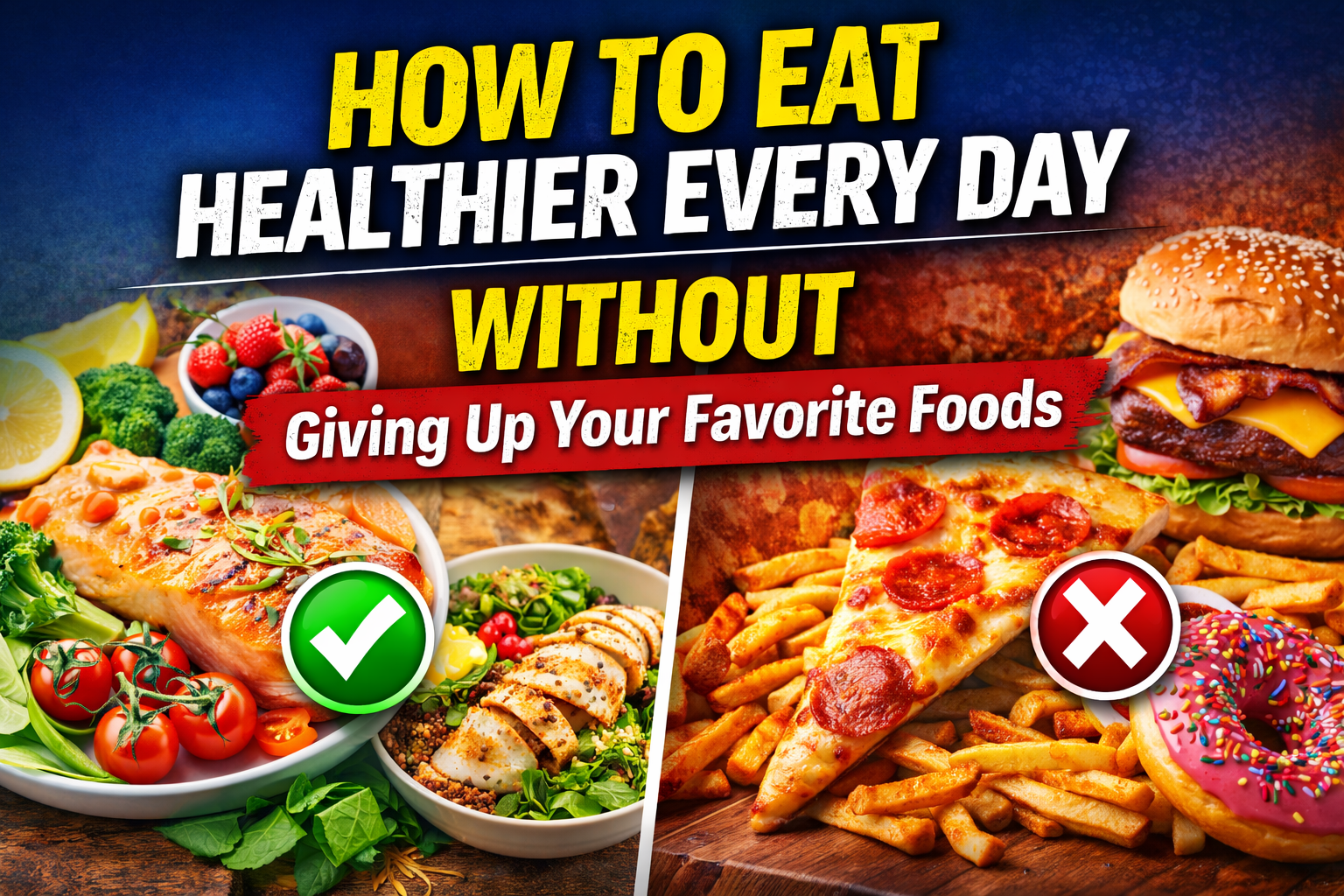
If you’ve ever tried to eat healthier, you probably started with a promise: “No more sugar. No more carbs. No more junk.” And for a few days, maybe even a few weeks, you felt unstoppable. Until real life happened. A birthday. A stressful day. A craving at 9 p.m. Suddenly, the “perfect” plan collapsed.
Here’s the truth: healthy eating doesn’t fail because you lack discipline. It fails because extreme rules fight human psychology. Research from institutions like Harvard Medical School shows that sustainable habits — not restriction — are what drive long-term health outcomes.
This guide will show you how to eat healthier every day without giving up your favorite foods. No extremes. No guilt. Just a smarter, science-backed approach you can actually maintain.
Overview:
The 80/20 Rule: The Science-Backed Balance Strategy
Upgrade, Don’t Eliminate: The Smarter Way to Improve Your Meals
Portion Control Without Obsessing Over Calories
How to Add Nutrients Before You Remove “Bad” Foods
Cravings Are Normal: Here’s How to Handle Them Intelligently
Build a Daily Structure That Makes Healthy Eating Automatic
Social Events, Restaurants, and Real Life: Staying Balanced Outside Home
The Mindset Shift: From Dieting to Lifestyle Identity
A Simple 7-Day Starter Plan to Begin Today
Why “All-or-Nothing” Dieting Fails (And What to Do Instead)
“All-or-nothing” thinking turns food into a moral battle: you’re either “good” or “bad.” But this mindset activates the brain’s stress response. According to behavioral research cited by Mayo Clinic, overly restrictive dieting often increases the likelihood of overeating later.
When you label foods as forbidden, they become psychologically more attractive. Then, when you inevitably eat them, guilt sets in — and many people abandon the plan entirely.
Instead, shift to a flexible consistency model. Aim for better choices most of the time, not perfect choices all the time. Health improves through patterns, not isolated meals. One burger doesn’t ruin your progress — just like one salad doesn’t transform it.
The 80/20 Rule: The Science-Backed Balance Strategy
The 80/20 rule means eating nutrient-dense foods about 80% of the time and enjoying less nutritious foods about 20% of the time. This approach supports adherence, which is the strongest predictor of long-term success.
Nutrition experts aligned with research from the National Institutes of Health emphasize dietary patterns over perfection. A sustainable eating pattern reduces chronic disease risk far more effectively than short-term dieting.
Practically, this could look like balanced meals during the week and a relaxed dinner on Saturday. The key is intention. Enjoy the 20% without guilt — and return to structure afterward.
Balance prevents burnout. And consistency beats intensity every time.
Upgrade, Don’t Eliminate: The Smarter Way to Improve Your Meals
Instead of removing foods, improve them. Love pizza? Add vegetables and choose a thinner crust. Enjoy burgers? Pair them with a side salad instead of fries.
Small upgrades compound over time. Research discussed by Cleveland Clinic shows that incremental dietary improvements significantly impact cardiovascular and metabolic health.
This strategy reduces psychological resistance. You’re not “losing” foods you love — you’re enhancing them.
Healthy eating isn’t about subtraction. It’s about strategic addition and smarter combinations.
Portion Control Without Obsessing Over Calories
Calorie counting works for some, but for many it becomes exhausting. Instead, focus on visual portion guidance.
The Centers for Disease Control and Prevention recommends practical portion awareness strategies, such as:
Half your plate vegetables
A palm-sized portion of protein
A fist-sized portion of whole grains
This method creates structure without obsession. You don’t need perfect math. You need repeatable habits.
Portion control is about awareness — not restriction.
How to Add Nutrients Before You Remove “Bad” Foods
Most people focus on cutting sugar or carbs. But a smarter strategy is adding fiber, protein, and healthy fats first.
When meals are nutrient-dense, cravings naturally decrease. According to dietary guidance supported by the National Institutes of Health, higher fiber and protein intake improves satiety and blood sugar stability.
Before eliminating dessert, ask:
Did I eat enough protein?
Did I include vegetables?
Did I hydrate properly?
Often, imbalance — not lack of willpower — drives overeating.
Cravings Are Normal: Here’s How to Handle Them Intelligently
Cravings are biological, not moral failures. Stress, sleep deprivation, and hormonal fluctuations all influence appetite regulation.
Research summarized by Harvard Medical School explains how sleep deprivation increases ghrelin (hunger hormone) and reduces leptin (satiety hormone).
Instead of fighting cravings aggressively:
Pause for 10 minutes
Drink water
Ask what you actually need — rest, comfort, stimulation
Sometimes, eat the craving mindfully. Satisfaction prevents rebound overeating.
Control isn’t suppression. It’s awareness.
Build a Daily Structure That Makes Healthy Eating Automatic
Willpower is unreliable. Structure is powerful.
Create anchor habits:
Eat protein at breakfast
Schedule lunch instead of skipping it
Keep healthy snacks visible
Behavioral science shows environment design strongly influences choices. Even simple strategies like pre-cut vegetables or visible fruit increase consumption rates.
Healthy eating becomes easier when the default option supports you.
Social Events, Restaurants, and Real Life: Staying Balanced Outside Home
Life includes birthdays, vacations, and date nights. A sustainable approach accounts for them.
When dining out:
Prioritize protein
Add vegetables
Split desserts
Public health experts from the Centers for Disease Control and Prevention emphasize overall dietary patterns, not single meals.
Enjoy experiences. Then return to your structure the next day. No compensation. No punishment.
Consistency lives in what you do repeatedly — not occasionally.
The Mindset Shift: From Dieting to Lifestyle Identity
The biggest transformation isn’t on your plate. It’s in your identity.
Instead of saying, “I’m on a diet,” try:
“I’m someone who values my health.”
Identity-based habits are more resilient. When healthy eating becomes part of who you are — not something you’re temporarily doing — decisions simplify.
You don’t need extreme motivation. You need alignment.
Lifestyle thinking creates longevity.
A Simple 7-Day Starter Plan to Begin Today
Day 1: Add a vegetable to one meal
Day 2: Increase protein at breakfast
Day 3: Drink more water
Day 4: Practice portion awareness
Day 5: Upgrade one favorite meal
Day 6: Plan meals ahead
Day 7: Enjoy a favorite food mindfully
Small steps. Daily wins. Compounding results.
You don’t need a radical overhaul. You need momentum.
Final Thoughts: Sustainable Health Starts with Flexibility
Eating healthier every day doesn’t require eliminating the foods you love. It requires balance, structure, and intelligent flexibility.
Science consistently shows that long-term patterns matter more than short bursts of perfection. Start small. Stay consistent. Adjust without guilt.
If this guide helped clarify your path, consider sharing it with someone who feels stuck in the diet cycle. And begin your 7-day plan today — not perfectly, but intentionally. Follow us 👉 @naturith.us
THIS INFORMATION DOES NOT SUBSTITUTE PROFESSIONAL MEDICAL ADVICE AND IS FOR EDUCATIONAL PURPOSES ONLY.